
P0016 Timing Correlation: Why a New Sensor Won’t Fix It
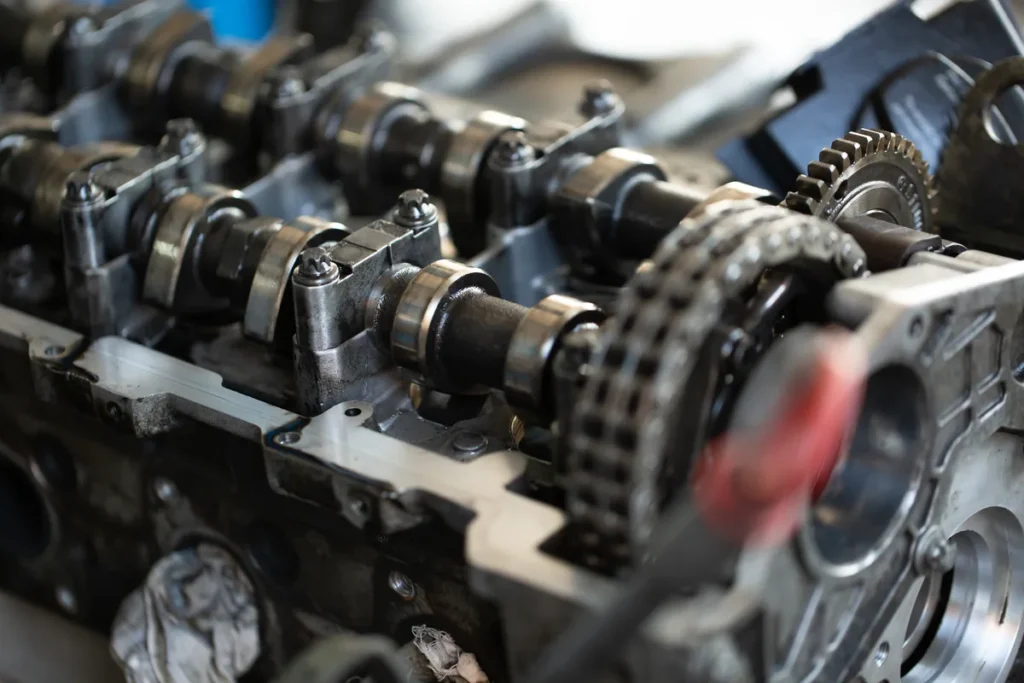
P0016 means the ECU compared where the crankshaft says the engine is with where the camshaft on bank one says it is, and the two do not agree. Both sensors can be working perfectly and the code will still set, because it reports a relationship, not a component. The real cause is usually mechanical: a stretched timing chain, a tired tensioner or guide, a belt that has jumped, or a variable valve timing phaser not holding position. Replacing the cam sensor is the classic wasted purchase on this code.
What the code actually means
The crankshaft position sensor reads a toothed wheel and tells the ECU where the pistons are. The camshaft position sensor reads a trigger on the camshaft and tells it where the valves are. Because the camshaft runs at half crank speed, the ECU knows precisely which cam signal edge should arrive at which crank angle, and it checks that relationship continuously.
When the cam signal turns up outside the window the ECU expects, the correlation test fails and P0016 is stored. Bank 1 Sensor A identifies which camshaft is involved: bank one contains cylinder one, and sensor A is normally the intake camshaft, though naming varies by manufacturer.
The consequence is that this is a positional complaint, not an electrical one. A circuit code such as P0335 or P0340 says a signal is missing or unusable. P0016 says both signals arrived cleanly and the numbers disagree. The ECU has effectively already told you the sensors are working.
On engines with variable valve timing there is one more layer. The cam phaser moves the camshaft deliberately, driven by oil pressure through an oil control solenoid, and the ECU compares actual against commanded position. If the phaser drifts, sticks or cannot hold where it was put, the correlation goes out even though the chain is fine.
That is why engine oil is a genuine root cause here rather than a footnote. Phasers and their solenoids are hydraulic devices with fine passages and small filter screens. Oil that is low, overdue, thickened or full of sludge cannot move them properly, and a tensioner that relies on oil pressure loses its grip on the chain. Plenty of P0016s trace back to missed services rather than broken parts.
Do not keep driving it
If your engine is an interference design, and most modern engines are, the pistons and valves occupy the same space at different moments. Timing that has slipped a little can slip a lot, and when it does the valves and pistons meet. That turns a chain job into a rebuild or a replacement engine. If the code is accompanied by a rattle on start-up, a rough idle or a loss of power, stop driving it and get it recovered rather than risking the journey.
Symptoms you’ll actually notice
Unlike many codes, P0016 usually comes with something you can hear or feel.
- A rattle for a second or two on cold start-up, the classic sound of a chain tensioner that has bled down overnight
- Rough or lumpy idle, sometimes with the engine hunting up and down
- Reduced power and poor throttle response, often with the car in a reduced-power mode
- Long cranking, and on badly affected engines a refusal to start at all
- Higher fuel consumption, because valve timing is not where the ECU wants it
- Misfire codes stored alongside, since timing that is out affects every cylinder
The start-up rattle deserves attention. A chain that rattles briefly when cold has slack in it, and slack is exactly what produces a correlation error. With both the noise and the code, you do not need much more evidence about where to look.
Likely causes, cheapest first
| Cause | Typical part cost | Why it’s on the list |
|---|---|---|
| Low, degraded or wrong-grade engine oil | Roughly £35 to £80 for oil and filter | Cheapest on the list and a genuine root cause, because the phasers and the tensioner are oil-driven. Check the level and the service history first. |
| Blocked or sticking VVT oil control solenoid, or its filter screen | Roughly £25 to £120 | Sludge in the fine passages stops the phaser being commanded properly. Some can be cleaned and refitted for the price of a gasket. |
| Wiring or connector fault at the cam or crank sensor | £0 to roughly £30 | Uncommon here but worth five minutes, since a small timing shift can look like a correlation error. |
| Worn cam phaser or a failed phaser locking pin | Roughly £120 to £500 per phaser | A phaser that cannot hold position throws the correlation out even with a perfect chain. |
| Worn chain tensioner or plastic guide | Roughly £60 to £250 for the parts | Guides crack, tensioners lose travel, the chain gains slack. One of the most common real causes. |
| Stretched timing chain, or a timing belt that has jumped a tooth | Roughly £150 to £500 for a full kit | The headline cause. Chains wear at every pin rather than truly stretching, and the accumulated wear shifts cam timing measurably. |
People see a code mentioning camshaft position and buy a camshaft position sensor. Here that is close to guaranteed money wasted, because the ECU only reached its conclusion by successfully reading both sensors. Spend it on an oil and filter change and an inspection instead. If you are unlucky, at least the timing job starts with fresh oil in it.
Narrowing it down with live data
The most informative parameter, where your car supports it, is camshaft timing: the position the ECU is commanding against the position it is measuring. On a healthy engine the actual value tracks the commanded one within a small margin and settles quickly when you blip the throttle. A gap that stays open, or an actual value that lags badly then overshoots, points at the phaser or its oil supply.
Watch engine RPM during cranking and at idle too. A steady cranking speed with the code still setting tells you both sensors are reporting cleanly, which supports the mechanical reading. Add coolant temperature, calculated load and fuel trims for context, since timing that is out shifts the trims.
Freeze frame is unusually helpful on P0016. Note whether the code set at cold start with low coolant temperature and idle load, or hot and under load. A cold-start capture fits a tensioner that has bled down overnight and lets the chain go slack for the first few seconds. A hot, high-load capture fits a phaser or oil-pressure problem that only shows when the oil is thin. Those are different repairs, and the snapshot is the cheapest way to tell them apart. Live data and freeze frame require the Enhanced edition or above; Standard reads and clears codes but does not display sensor values, and the edition list spells that out.
Garage bill versus doing it yourself
| Job | Typical UK garage | DIY parts only |
|---|---|---|
| Diagnosis, commonly around an hour of labour | Roughly £50 to £120 | Your own adapter and software |
| Oil and filter change to rule out oil-related causes | Roughly £80 to £180 | Roughly £35 to £80 |
| VVT oil control solenoid replaced | Roughly £120 to £350 | Roughly £25 to £120 |
| Timing chain, tensioner and guides on a straightforward engine | Roughly £600 to £1,200 | Roughly £150 to £500 for a kit |
| Timing chain on an engine needing the box out or the engine out | Commonly £1,200 to £2,500 and sometimes more | Not realistic without a workshop |
Be prepared for this one to run into four figures. Timing work is dominated by access rather than parts: on some engines the chain sits behind a cover you can reach with the car on axle stands, and on others the whole front of the engine, or the gearbox, has to come out first. UK garages usually charge diagnosis at about an hour of labour, and hourly rates vary widely between independents and franchised dealers and between regions, which is why every figure above is a range and not a quote. Get two written estimates for your exact engine before committing.
When this is a DIY job and when it isn’t
What you can sensibly do
Check the oil level and condition, look at the service history, and change the oil and filter with the correct grade if there is any doubt. On many engines the VVT solenoid is accessible from the top with one bolt, and cleaning or replacing it is a reasonable home job. Reading the codes, capturing the freeze frame and listening for a start-up rattle all cost nothing and genuinely narrow the diagnosis.
Where it stops being a home job
Timing chain and belt work is not a first project. It needs engine and camshaft locking tools specific to your engine, a torque wrench and often torque-to-yield bolts that must be renewed, correct tensioner priming, and in some cases a scan tool relearn afterwards. Get the timing out by one tooth on an interference engine and you will bend valves the moment it turns over. This is normally a garage job, and there is no shame in that: many experienced home mechanics send timing work out for exactly this reason.
Clearing the code the right way
There is no version of this code where clearing is the answer. Fix the mechanical cause first, then clear, then run the engine and check it stays away. If it returns immediately, the timing is still out, and that is a valuable test rather than a wasted trip.
Understand the pending and stored distinction here. The ECU records the fault as pending on first detection and confirms it as stored when it recurs. After a chain job, a pending P0016 reappearing means the correlation is still marginal, which is worth knowing before you put the car back on the road rather than after.
Clearing also resets the readiness monitors, so the emissions self-tests will read as incomplete until the car has completed a proper mix of driving. Never clear this code to silence the light and carry on. Of all the codes on a modern engine, this is one of the few where ignoring it can cost you the engine.
What it means for your MOT
An engine management light that stays on is an MOT failure in its own right on any petrol car first used from July 2003 or diesel from July 2008, and a mistimed engine can fail the emissions element as well. (Across the Atlantic, an emissions or smog check fails the same car twice over, on the illuminated lamp and on readiness monitors that have not completed.) Clearing the code before the test replaces one failure with another and leaves a mechanical fault untouched. Repair the timing, let the car complete its own self-checks over a few days of normal driving, then present it.
Confirm what is stored before anyone quotes you
Knowing whether P0016 sits alone or alongside misfire and cam sensor codes changes the conversation with a garage considerably. AutoScan runs on Windows with an ELM327 lead and carries a database of 14,309 fault codes.
Read it yourself
Stop guessing at the code
AutoScan reads the fault straight out of your car and tells you what it means in plain English, on your own Windows laptop. The trial reads real codes before you pay anything.
Keep reading
Related guides
P0011 Cam Timing Over-Advanced: Start With the Oil
Variable valve timing runs on engine oil, so this code often comes down to oil condition rather than a worn phaser. Here…
P0401 EGR Flow Insufficient: Carbon, Cleaning and Costs
Why the EGR system exists, how the ECU works out that too little exhaust gas is getting through, and when cleaning the…
P0455 Large EVAP Leak: Start With the Fuel Cap
A large evaporative leak is the one EVAP fault you can often find yourself in five minutes, and the fuel cap is…