
P0420: Why It Is Rarely Just the Catalytic Converter
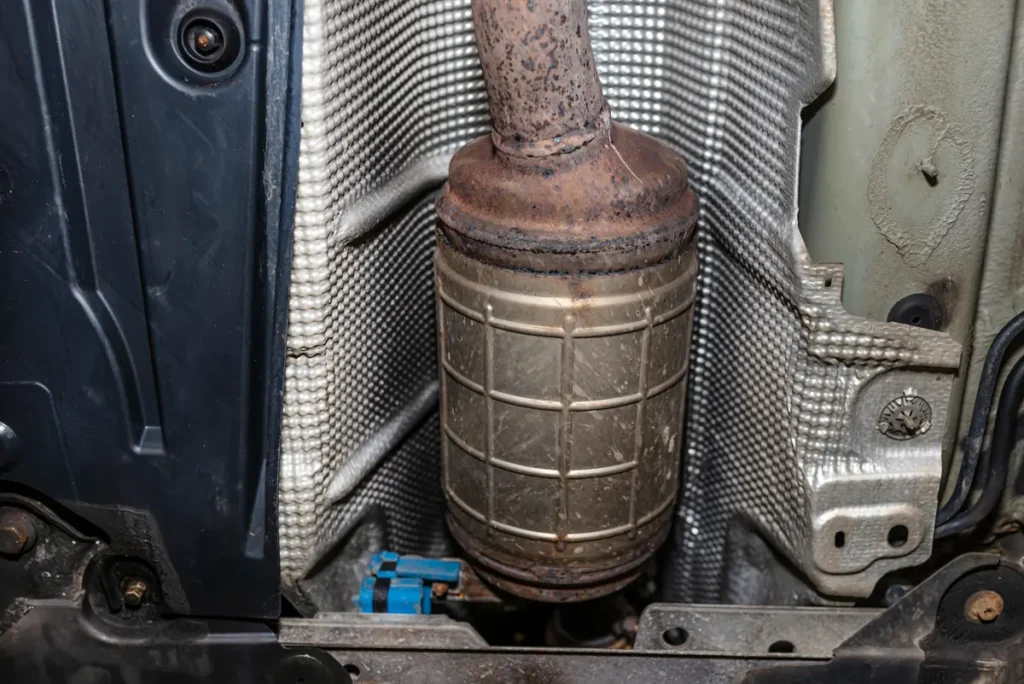
P0420 does not say your catalytic converter has failed. It says the ECU compared the oxygen sensor in front of the converter with the one behind it and decided the two signals had begun to look too much alike. A tired rear lambda sensor, a small exhaust leak, or an engine fault that has been quietly cooking the converter for months all produce the same picture. The converter is the conclusion you reach last, not the part you buy first.
What the code actually means
A modern petrol car carries an oxygen sensor either side of the catalytic converter. The upstream one trims fuelling in closed loop. The downstream one has nothing to do with fuelling; its only job is to mark the converter’s homework.
A healthy three-way catalyst behaves like a small oxygen sponge: it stores surplus oxygen when the mixture swings lean, then gives it back when the mixture swings rich to finish burning the leftover fuel. So the front sensor sees a signal flicking between rich and lean several times a second, while the rear sensor sees something smoothed out and lazy, drifting slowly around the middle of its range.
The ECU checks this with a catalyst monitor that runs only in a narrow window: fully warm, closed loop, a steady cruise inside a set load and speed band. It measures how much the rear signal moves relative to the front. If the rear has begun mirroring the front’s switching, the ECU concludes the coating is no longer storing oxygen, and after consecutive failed drive cycles P0420 is stored. Bank 1 means the bank containing cylinder one, which on an in-line four is the only one there is.
The trap is now obvious. The ECU never looked at your converter; it inferred a conclusion from two voltage traces. Anything that makes the rear trace livelier than it should be lands in the same place, including a worn downstream sensor and an exhaust leak ahead of or between the sensors letting fresh air into the pipe. And converters rarely die of old age behind a healthy engine. They die because a misfire, a rich or lean mixture, or oil and coolant getting past worn seals has been poisoning or overheating them for months.
Quick check
Read the full code list, not just the one that lit the lamp. A P0420 sitting alongside a misfire code, a lean or rich bank code, or a coolant loss you keep topping up means you have found the real job.
Symptoms you’ll actually notice
For most drivers, very little, which is part of the problem. The car feels normal and the light is easy to ignore.
- A steady engine management light and nothing else at all.
- A small drop in economy, usually only where the cause is a fuelling fault.
- A sulphur or rotten-egg smell, pointing at a converter fed too much fuel.
- A rattle from underneath over bumps, meaning the ceramic inside has broken up.
- Sluggish acceleration, which is a blocked converter rather than an inefficient one.
If the lamp is flashing rather than steady, stop treating this as a P0420 problem. Flashing means an active misfire bad enough to damage the converter, and carrying on turns a sensor job into a converter job.
Likely causes, cheapest first
| Cause | Typical part cost | Why it’s on the list |
|---|---|---|
| Another stored fault: misfire, rich or lean mixture, oil or coolant loss | Cost of that repair, from a set of plugs upward | The usual reason a converter lost efficiency; fixing it may clear the P0420 outright. |
| Exhaust leak before or between the sensors | Nothing for a slipped clamp, roughly £10 to £30 for a gasket or paste | Air drawn in through a blowing joint reads exactly like a converter not storing oxygen. |
| Chafed or corroded lambda wiring and connectors | A few pounds in terminals and heatshrink | These looms run along a hot, salted exhaust; a green connector fakes a bad sensor. |
| Downstream lambda sensor worn or slow | Roughly £25 to £90 aftermarket | An ageing rear sensor turns twitchy and reproduces the front sensor’s switching. |
| Upstream lambda sensor skewed | Roughly £30 to £120 | A drifting front sensor holds fuelling rich or lean, tripping the monitor. |
| Catalytic converter worn out or contaminated | Commonly several hundred pounds, more for a genuine part | Real, but the last name on the list. |
Order matters more here than on almost any other code, because the gap between cheapest and dearest is enormous. The classic sequence: someone reads P0420, buys a converter, and watches the light return a fortnight later, because whatever killed the first one is still doing the same job on the second.
On replacement converters
If it really is the converter, buy a type-approved unit made for your vehicle. Cheap universal converters frequently re-trigger the code within weeks, because there is not enough coating inside to satisfy the monitor. Anything sold to fool the rear sensor rather than do its job is an MOT failure and not legal on the road.
Narrowing it down with live data
Start with the freeze frame, the snapshot the ECU saved when the fault was confirmed. Check coolant temperature, engine speed, calculated load and road speed. A fault captured at a steady motorway cruise on a hot engine is the catalyst monitor doing its normal work; captured somewhere odd, treat it with suspicion.
Then watch both lambda sensors live on a warm engine. On most petrol engines the upstream sensor should swing rapidly across roughly 0.1 V to 0.9 V, several crossings a second, and look busy. The downstream one should look bored: a comparatively flat line in the middle to upper part of its range, moving slowly if at all. That contrast is the entire test.
Now separate the candidates. If the rear trace switches almost in step with the front, in speed and amplitude, the converter or the rear sensor is in play. If it is noisy rather than merely active, with spikes matching nothing the front sensor did, suspect the sensor or its wiring. If it sits stubbornly at the lean end, that fits air getting into the exhaust, so hunt for a leak.
Fuel trims tell you whether the engine is at fault. Long-term trim beyond about plus or minus 10% is worth investigating, and beyond roughly 25% the ECU has run out of adjustment, so fix the fuelling before blaming the converter. Compare trims at idle and at a steady 2,500 rpm: a vacuum leak looks worst at idle, a fuel delivery problem worst under load. Live data and freeze frame come with AutoScan Enhanced and above, and there are 13 video tutorials if you would rather watch the graphs read on a real car first.
Garage bill versus doing it yourself
| Job | Typical UK garage | DIY parts only |
|---|---|---|
| Diagnostic session | Roughly £50 to £120 | Your time, plus a lead and software |
| Exhaust joint or small leak repaired | Roughly £40 to £120 | £5 to £30 in clamps or paste |
| Downstream lambda sensor replaced | Roughly £90 to £200 | £25 to £90 |
| Upstream lambda sensor replaced | Roughly £100 to £250 | £30 to £120 |
| Type-approved converter replaced | Commonly £400 to well over £1,000 fitted | Several hundred pounds for the part alone |
UK garages generally charge diagnostic work at around an hour of labour, and rates vary a great deal by region and by car. Every figure above is a range for a reason, so treat them as the shape of a bill rather than a quote.
When this is a DIY job and when it isn’t
Reasonable at home
Reading codes, reading the freeze frame and watching both lambda sensors costs nothing but time. Hunting an exhaust leak is a home job too: idling from cold you can often hear a blowing joint, and soot streaked around a seam is a strong clue. Swapping a downstream sensor is within reach if you can get the car safely onto axle stands on level ground.
Hand it over
Converter replacement usually is not a driveway job: corroded fasteners, sometimes cutting and welding, and a heavy awkward part. Sensor removal is the other trap. Work on a warm exhaust rather than a hot one, use a slotted lambda socket instead of an open spanner, soak the threads and give the oil time, and stop if it feels like it is about to shear. Snapping a sensor off in a flange turns a modest bill into a large one, so if the threads look bad, let a garage carry that risk.
Clearing the code the right way
Fix the fault, then clear the code, in that order. Clearing first tells you nothing and throws away the freeze frame, which is the best evidence you have.
It helps to know pending from stored. Most emissions faults must fail on more than one drive cycle before the ECU commits, so a pending code means it saw something once and is watching; a stored code with the lamp on means it saw it again and is sure.
Clearing also resets the readiness monitors, the ECU’s internal self-tests, and the catalyst monitor is among the fussiest, needing a mixed drive with a decent warm cruise. That is why clearing a code on the morning of a test is a bad idea, not a clever one. Fix it properly and the code stays away while the monitors complete over a few days of ordinary driving. If it returns, you have learned something real.
What this means for your MOT
In the UK the lamp is an inspected item on petrol cars first used from July 2003, and one still lit is a Major defect, so a P0420 with the light on will not pass however well the car drives. Wiping it beforehand does not help, since the tester can see whether the lamp behaves correctly, and in the US equivalent a smog check fails on an illuminated light and on incomplete readiness monitors. The only route through is the boring one.
See the sensor traces for yourself
P0420 is a comparison between two signals, so the quickest way to settle it is to watch both live rather than guess.
Read it yourself
Stop guessing at the code
AutoScan reads the fault straight out of your car and tells you what it means in plain English, on your own Windows laptop. The trial reads real codes before you pay anything.
Keep reading
Related guides
P0455 Large EVAP Leak: Start With the Fuel Cap
A large evaporative leak is the one EVAP fault you can often find yourself in five minutes, and the fuel cap is…
P0300 Random Misfire: What Causes It and How to Find It
Why a random misfire code almost always points at something every cylinder shares, how the ECU detects it, and the order to…
P0171 System Too Lean (Bank 1): Causes and Real Fix Costs
What a lean code on bank 1 really tells you, how to read fuel trim properly, the causes in order of likelihood…