
P0128 Coolant Thermostat: Why the Engine Never Warms Up
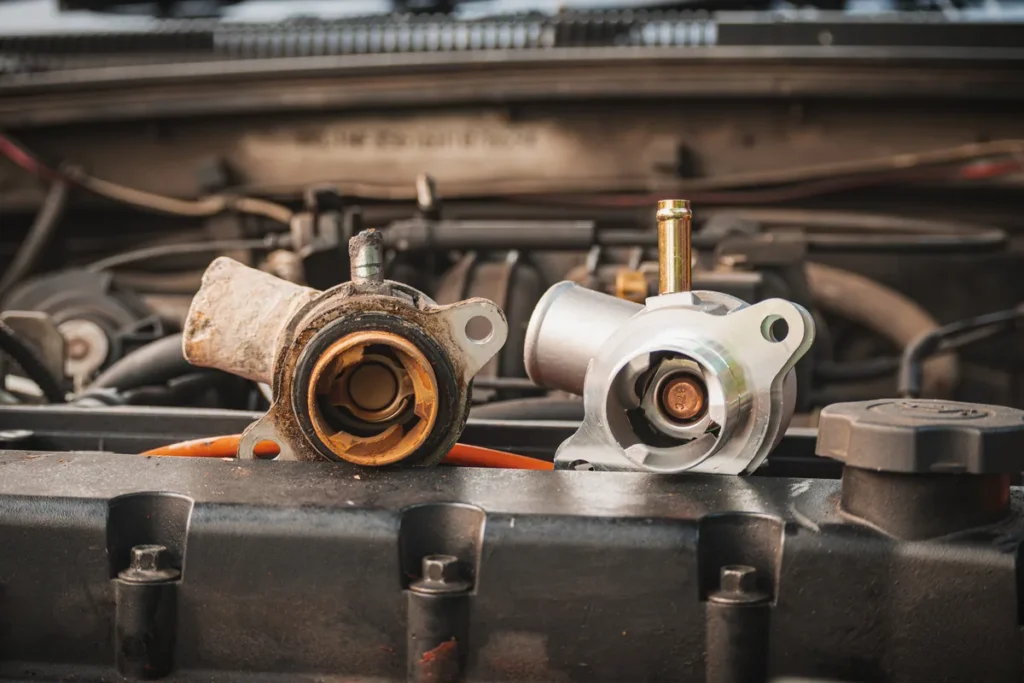
P0128 is the ECU reporting that the coolant never reached the temperature it expected, in the time it expected. It is a timing judgement, not a reading from one broken component. In practice it nearly always means a thermostat stuck open, though a coolant sensor telling fibs, a low coolant level or a fan that never switches off produce the same complaint.
What the code actually means
The thermostat is a simple valve, usually with a wax capsule inside that expands as it heats. While the engine is cold the valve stays shut and coolant circulates around the block and head rather than the radiator, so the engine warms as fast as it can. Once the coolant reaches the rated opening temperature the valve opens and lets coolant through the radiator to shed heat.
The ECU knows what should happen next. From the coolant temperature at start-up, the intake air temperature, run time and how much air the engine has drawn, it models how long warm-up ought to take and what temperature should have been reached, then compares that against what the coolant sensor reports.
If the measured temperature falls short of the expected threshold within the expected window, P0128 is stored. Note the two halves of that test: the engine can be too cold, or simply too slow to warm. It is also why the fault often appears in winter and vanishes in July, because a marginal thermostat that copes in mild weather cannot keep up with cold air pouring through the radiator.
A thermostat almost never fails shut. Wax capsules tend to give up open, which is the safer failure by design, since a valve stuck closed would cook the engine. Stuck open simply means the engine is being cooled whether it needs it or not. The code applies to petrol and diesel alike, and on diesels the consequences are usually worse.
Symptoms you’ll actually notice
Unlike a lot of emissions codes, this one you can feel from the driver’s seat:
- Weak or lukewarm cabin heat, especially on short journeys
- A temperature gauge sitting below its usual position, or slow to move
- Fuel consumption noticeably worse, often by a real margin in winter
- The gauge dropping back down once you get onto a fast road
- Slow demisting and windows that stay fogged
- On a diesel, more frequent or failed DPF regeneration attempts
None of that is dangerous the way overheating is, which is why plenty of people drive like this all winter. The cost is real all the same.
Likely causes, cheapest first
| Cause | Typical part cost | Why it’s on the list |
|---|---|---|
| Low coolant level | £10 to £25 for coolant | Air pockets round the thermostat and sensor give false readings. Free to check. |
| Thermostat stuck open | £10 to £45 for the thermostat alone | The overwhelming favourite. The part is cheap; fitting it is another matter entirely. |
| Thermostat previously removed | Cost of a new one | Worth checking on an older car, where someone may have removed it to cure an overheat. |
| Coolant sensor reading low or lazily | £10 to £40 | If the sensor under-reports, the engine may be warm while the ECU thinks otherwise. |
| Cooling fan running constantly | £20 to £120 for a relay, switch or module | A fan stuck on drags heat away faster than the engine makes it. Listen for it running with a cold engine. |
| Thermostat housing assembly failed | £40 to £160 | Many modern engines build thermostat, sensors and heater into one plastic housing, supplied as a single unit. |
| Wiring fault to a map-controlled thermostat heater | £0 to £40 | The ECU can force these open, so a circuit fault can leave one open when it should be shut. |
The ordering matters here for a different reason than usual. None of these parts will ruin you. What varies enormously is the labour, which depends on which part is at fault and where it lives, so confirming the cause before booking work is what protects your wallet.
Quick check
Start the car from stone cold and, after a few minutes, feel the top radiator hose. It should stay cool while the engine warms, then turn hot fairly suddenly as the thermostat opens. A hose that warms gradually from the start suggests coolant is going through the radiator when it should not be. Keep hands clear of the fan, which can start without warning.
Narrowing it down with live data
The definitive test is to watch the engine warm up, which means starting the session before you start the engine. With the car cold, log coolant temperature, intake air temperature, engine speed and, if reported, fan status and thermostat duty cycle. Before starting, coolant and intake air should read within a few degrees of each other and of the outside air. If they do not, the coolant sensor is suspect and needs sorting before you condemn a thermostat.
Now start the engine and watch the coolant figure climb. On a healthy engine it rises steadily and settles into the normal operating band, which on most modern cars sits from the high eighties to the low hundreds in Celsius. Check your own car’s specification rather than assuming a number, since thermostats are rated differently across models.
The failure pattern is unmistakable once you have seen it. A stuck-open thermostat gives a temperature that climbs slowly, plateaus well below the normal band and sits there. Take the car onto a fast road and the reading often falls back rather than holding. No other fault imitates that convincingly.
If instead the temperature rises normally and reaches the usual band while the code still sets, look harder at the sensor and its wiring, or at whether a fan is running when it should not be. Comparing the dashboard gauge with the live reading helps too, since many gauges are damped and show normal across a wide band.
Freeze frame adds the conditions the fault was recorded under: coolant temperature, ambient air temperature, engine speed and run time at the moment the ECU gave up waiting. A code frozen at a low coolant temperature after a long run time is about as clear as evidence gets. Live data and freeze frame belong to the higher editions, and there is a walkthrough among the video tutorials.
Garage bill versus doing it yourself
| Job | Typical UK garage | DIY parts only |
|---|---|---|
| Diagnosis and a cold warm-up test | £50 to £110 | Your time and a cold start |
| Replace coolant temperature sensor | £60 to £150 | £10 to £40 plus coolant |
| Replace an accessible thermostat | £90 to £220 | £10 to £45 plus coolant |
| Replace a buried thermostat or housing | £250 to £600 | £40 to £160 plus coolant |
| Repair a fan that runs constantly | £70 to £250 | £20 to £120 |
Diagnostic time in the UK is commonly charged at about an hour of labour, at rates typically from around £50 to £130 and more at a franchised dealer. The spread in that table is not about the parts. On some engines the thermostat is out in half an hour; on others it is behind the inlet manifold or reachable only from below, and the labour multiplies. Get a price for your specific engine first.
When this is a DIY job and when it isn’t
A reasonable weekend job
Where the thermostat sits in an obvious housing you can reach from above, this is rewarding work. Drain the coolant into a clean container, unbolt the housing, note which way round the old one sits, fit the new one with a fresh gasket or O-ring and torque the bolts properly, because these housings are often plastic and crack easily. Refill with the correct coolant specification and bleed the system as the manufacturer specifies, since an air pocket can cause genuine overheating.
When to book it in
If the thermostat is buried, the calculation changes fast. Jobs needing the inlet manifold off or the car on a lift are not weekend work.Where the housing is an integrated assembly carrying sensors and a heater, fit it complete rather than putting a bare thermostat into an aged plastic body, which distorts with heat and usually weeps afterwards. And if the coolant was low, find out where it went before spending anything.
Clearing the code the right way
Fix it, clear it, then let the car prove the repair on its own terms. The proof for P0128 is a cold start followed by a warm-up curve that settles in the right band and stays there on a motorway run. A pending code is the ECU saying it has seen the fault once and is waiting to see it again. Because this code depends on ambient temperature, a marginal repair can pass unnoticed in mild weather and reappear at the first frost, so check for pending codes through a cold snap.
Clearing codes wipes the readiness monitors along with the fault, and those need a full drive cycle to complete, which is a good reason not to clear anything shortly before a test. Clearing P0128 to make the light go out is particularly pointless, because the underlying problem is silently costing you fuel on every journey.
The MOT and why cold running matters
In the UK an engine management light that remains illuminated is a failure item in its own right on petrol cars first used from July 2003 and diesels from July 2008, so P0128 will stop the car passing its MOT even though it is not a dramatic fault. There is a second-order effect too: an engine that never warms properly spends longer in open loop enrichment, runs rich and gives the catalytic converter a harder life. (An American emissions or smog check fails on an illuminated lamp and on incomplete monitors in the same way.) Cold running is mechanically expensive too, since fuel condensing on cold cylinder walls washes oil off them and thins the oil in the sump.
Watch it warm up once and you will know
One logged warm-up from cold shows whether coolant temperature reaches the normal band or stalls below it, which is the difference between a thermostat and a sensor. AutoScan is Windows software for ELM327 adapters, with a one-off licence key and no subscription.
Read it yourself
Stop guessing at the code
AutoScan reads the fault straight out of your car and tells you what it means in plain English, on your own Windows laptop. The trial reads real codes before you pay anything.
Keep reading
Related guides
P0301 Cylinder 1 Misfire: Find the Cause Before Buying Parts
How to use the coil and injector swap test to prove which part is faulty on cylinder one, so you replace the…
P0171 System Too Lean (Bank 1): Causes and Real Fix Costs
What a lean code on bank 1 really tells you, how to read fuel trim properly, the causes in order of likelihood…
P0455 Large EVAP Leak: Start With the Fuel Cap
A large evaporative leak is the one EVAP fault you can often find yourself in five minutes, and the fuel cap is…