
P0102 Mass Air Flow Circuit Low Input: Sensor or Symptom?
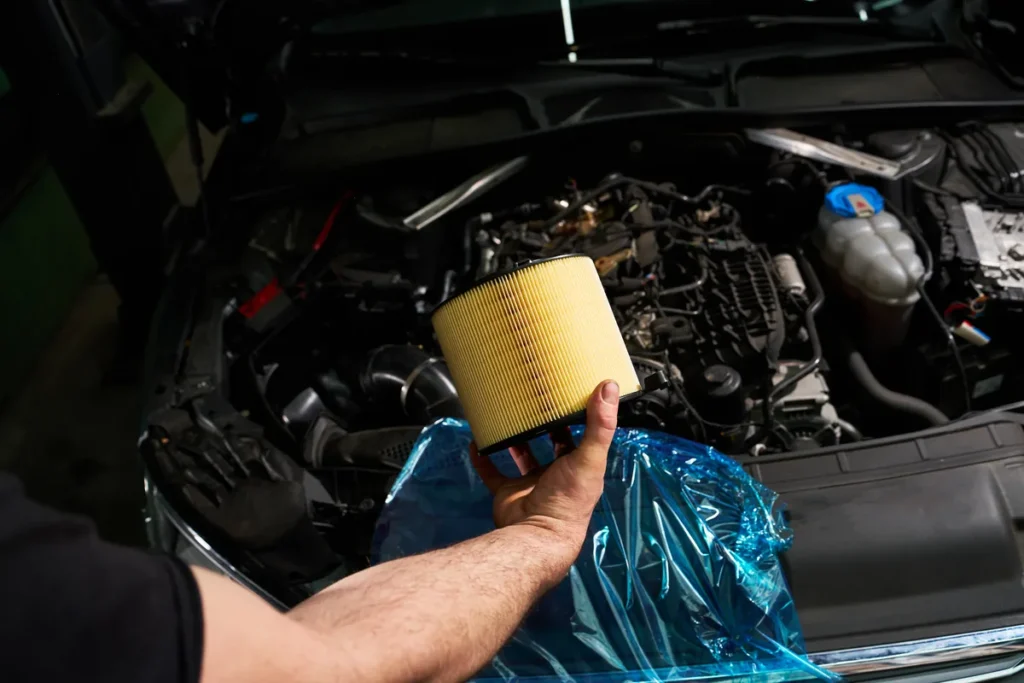
P0102 means the signal reaching the ECU from the mass air flow sensor is lower than the ECU believes is possible for the engine speed and throttle position it can see. That is a statement about a signal, not a verdict on a part. A dirty hot wire, a collapsed intake duct, a split pipe downstream of the sensor or one corroded pin all produce the same complaint from a sensor that may be perfectly good.
What the code actually means
The mass air flow sensor sits between the air filter and the throttle body. Inside is a tiny electrically heated element, either a fine wire or a thin film, held at a set temperature above the incoming air. Air rushing past cools it, the electronics work out how much current it takes to keep that element hot, and the answer becomes a measurement of the mass of air entering the engine, in grams per second.
That figure matters because fuelling is calculated from it. The ECU takes the measured air mass, works out how much petrol is needed to burn it properly, and sets the injector opening time to match. Get the air measurement wrong and the fuelling is wrong from the first millisecond.
Depending on the design, the sensor reports as a varying voltage or as a frequency. The ECU knows roughly what to expect for the engine speed, throttle angle and load it sees from other sensors, and when the reported figure drops below the lowest plausible value for those conditions it stores P0102.
Read the wording carefully. The code says the input is low; it does not say the sensor is broken. Three different things land in the same place: real airflow being lower than expected, the sensor under-reporting air that is genuinely there, and the signal being weakened on the way to the ECU. Telling those apart is the whole job.
Symptoms you’ll actually notice
Unlike many emissions codes, this one usually shows up in how the car drives:
- Hesitation, stumbling or a flat spot under acceleration
- Poor throttle response, as though something is holding the car back
- A rough, hunting or unusually low idle, sometimes stalling as you stop
- Hard starting, particularly when the engine is already warm
- Black smoke on some cars, a lean stumble on others, depending on how the ECU compensates
- Lean codes such as P0171 keeping it company
Many cars drop into a default strategy when the airflow signal is rejected, ignoring the sensor and running from a stored table instead. That often feels flat but oddly stable, which is a clue in itself.
Likely causes, cheapest first
| Cause | Typical part cost | Why it’s on the list |
|---|---|---|
| Contaminated hot wire or film | £6 to £10 for MAF cleaner | Dust, oil mist and varnish insulate the element so it cools more slowly, and the sensor reports less air than is really passing. |
| Blocked or sodden air filter, or a blocked intake snorkel | £8 to £30 | A genuine restriction means genuinely low airflow. Leaf litter in the airbox inlet is commoner than people expect. |
| Oiled aftermarket performance filter | £10 to £45 for a paper element | Over-oiled gauze sheds mist that coats the element, and the contamination returns unless the filter goes. |
| Split, loose or disconnected intake pipe after the sensor | £0 to £60 | Air entering through the split never passed the sensor, so measured flow sits below what the engine is breathing. |
| Dirty, corroded or spread connector pins | £0, or £8 to £20 for a pigtail | Resistance in the plug weakens the signal or the sensor’s supply. Water ingress is a classic on cars parked outside. |
| Damaged wiring or a poor earth | £0 to £25 | A chafed loom gives a signal that is low or intermittent rather than absent. |
| Genuinely failed sensor | £35 to £180 | Last on the list because it is the priciest item and the one people buy first. |
The reason for that order is simple economics. A replacement airflow sensor is the obvious purchase when a code has “mass air flow” in the name, and it is the most commonly wasted part on this fault. Cleaning costs a few pounds and checking the ducting costs nothing, and between them they settle a great many P0102s.
Cleaning it properly
Use a purpose-made MAF cleaner aerosol and nothing else. Never brake cleaner, carburettor cleaner or petrol, which attack the coating and the plastic housing. Unplug the sensor, remove it, spray the element from a short distance and let the solvent carry the deposits away. Do not touch the wire or film with a cloth, a cotton bud or a finger, and let it dry fully before refitting.
Narrowing it down with live data
Watch mass air flow in grams per second alongside RPM, throttle position, calculated load and both fuel trims. Live data and freeze frame need an edition that supports them; the entry-level one reads and clears codes but shows no sensor readings.
There is a rough sanity check mechanics have used for years on naturally aspirated petrol engines. At a warm idle, airflow tends to land in the low single digits of grams per second. At full throttle near the power peak, the figure in grams per second is loosely comparable to the engine’s horsepower. Treat that as a smell test rather than a specification, because it does not hold for turbocharged or supercharged engines and every design differs. What it is good for is spotting a reading nowhere near plausible, such as a fraction of a gram per second at idle on a two-litre engine.
Behaviour matters more than any single number. With the car stationary and safe, snap the throttle open: airflow should rise smoothly and at once, then fall back cleanly. A reading that jumps and sticks, drops briefly to zero, or moves in steps points at a signal problem rather than an airflow problem. Wiggling the connector and harness while watching the live figure often reproduces an intermittent fault on the spot.
Fuel trims separate the two big families of cause. If the sensor under-reads but the intake is intact, the ECU under-fuels and trims positive to correct it. If air is getting in through a split downstream, you get the same positive trims plus a measured flow that is low for the load shown. If the restriction is upstream, a blocked filter for instance, airflow is low because the airflow really is low, and the trims stay closer to normal because the measurement is still honest.
Freeze frame narrows it further by recording engine speed, load and coolant temperature when the fault set. A code captured only at high load suggests a restriction or a sensor failing at the top of its range; one captured at idle suggests wiring or heavy contamination.
Garage bill versus doing it yourself
| Job | Typical UK garage | DIY parts only |
|---|---|---|
| Diagnostic time on the airflow circuit | £50 to £110 | Half an hour and a torch |
| Clean the sensor and fit a new air filter | £40 to £90 | £14 to £40 |
| Repair or replace the intake ducting | £60 to £180 | £15 to £60 |
| Repair a connector or wiring fault | £60 to £160 | £8 to £25 |
| Replace the mass air flow sensor | £90 to £300 | £35 to £180 |
Diagnostic work is commonly charged at around an hour of labour in the UK, at rates that typically run from about £50 to £130 an hour and higher at a franchised dealer. The sensor price varies far more than the labour, because some cars take a bare element that clips into the housing while others only offer a complete assembly. Costs differ enormously between models, so get a price for your own car before committing.
When this is a DIY job and when it isn’t
Straightforward at home
Cleaning the sensor, changing the air filter, checking the airbox for debris and going over every clip between airbox and throttle body are all within reach with hand tools. Airflow sensors are usually held by two small screws or Torx fasteners and one plug. The only real care needed is with the element, which one careless prod can ruin. There are walkthroughs among the video tutorials if you would rather see the live data side done first.
Leave it to a garage
Chasing an intermittent wiring fault properly means back-probing the connector with a meter while the engine runs, checking supply, earth and signal against the manufacturer’s figures, and following the loom to wherever it has chafed. That is skilled work, and piercing insulation makes things worse. If you have cleaned, checked and replaced the obvious and the code still comes back, pay for an hour of proper diagnosis rather than buying a second sensor.
Clearing the code the right way
Repair first, then clear, then verify. Because P0102 usually affects how the car drives, the road test after clearing tells you a lot: an engine that pulls cleanly and idles evenly with no return of the code is a repair you can trust. Keep the distinction between pending and stored codes in mind too. A pending code is one the ECU has seen once and not yet confirmed; a stored one has met the criteria enough times to light the lamp.
Clearing also wipes the readiness monitors, the self-checks the ECU runs on the emissions systems in the background. They only complete after a drive cycle covering town speeds and a sustained run, so do not clear codes the morning of an inspection. And never treat clearing as the repair, since hiding a genuine airflow fault leads to poor economy and, in time, a fouled catalytic converter.
The MOT side of it
In the UK the tester checks that the engine management light comes on with the ignition and then goes out, and a lamp still lit is a Major defect on petrol cars first used from July 2003, so this code has to be resolved rather than reset. There is a practical angle too: a car fuelling from a bad airflow reading may run rich enough to push the tailpipe figures over the limit, and a persistently rich mixture is one of the reliable ways to destroy a catalytic converter. (In the United States an emissions or smog check fails on both an illuminated lamp and on readiness monitors that have not yet run.)
Check the airflow figure before you replace the sensor
A live grams-per-second reading takes a minute to look at and often saves a three-figure part. AutoScan is Windows software for ELM327 adapters, with a 14,309-code database and a one-off licence key covering unlimited vehicles.
Read it yourself
Stop guessing at the code
AutoScan reads the fault straight out of your car and tells you what it means in plain English, on your own Windows laptop. The trial reads real codes before you pay anything.
Keep reading
Related guides
P0420: Why It Is Rarely Just the Catalytic Converter
What the ECU is really measuring when it stores P0420, the cheaper faults that produce an identical reading, and how to check…
P0128 Coolant Thermostat: Why the Engine Never Warms Up
P0128 means your engine is not reaching its expected temperature in the expected time. What that costs in fuel and wear, how…
P0401 EGR Flow Insufficient: Carbon, Cleaning and Costs
Why the EGR system exists, how the ECU works out that too little exhaust gas is getting through, and when cleaning the…