
Do You Need to Pay for OBD2 Software? Free vs Paid

For a lot of people, no. If you want to know why a light is on, once, a free app and a working adapter will tell you. Paying starts to make sense when you need the code explained rather than just numbered, when you need to see what the engine is doing rather than what it recorded, or when you are going to do this more than once. Here is where the line actually falls.
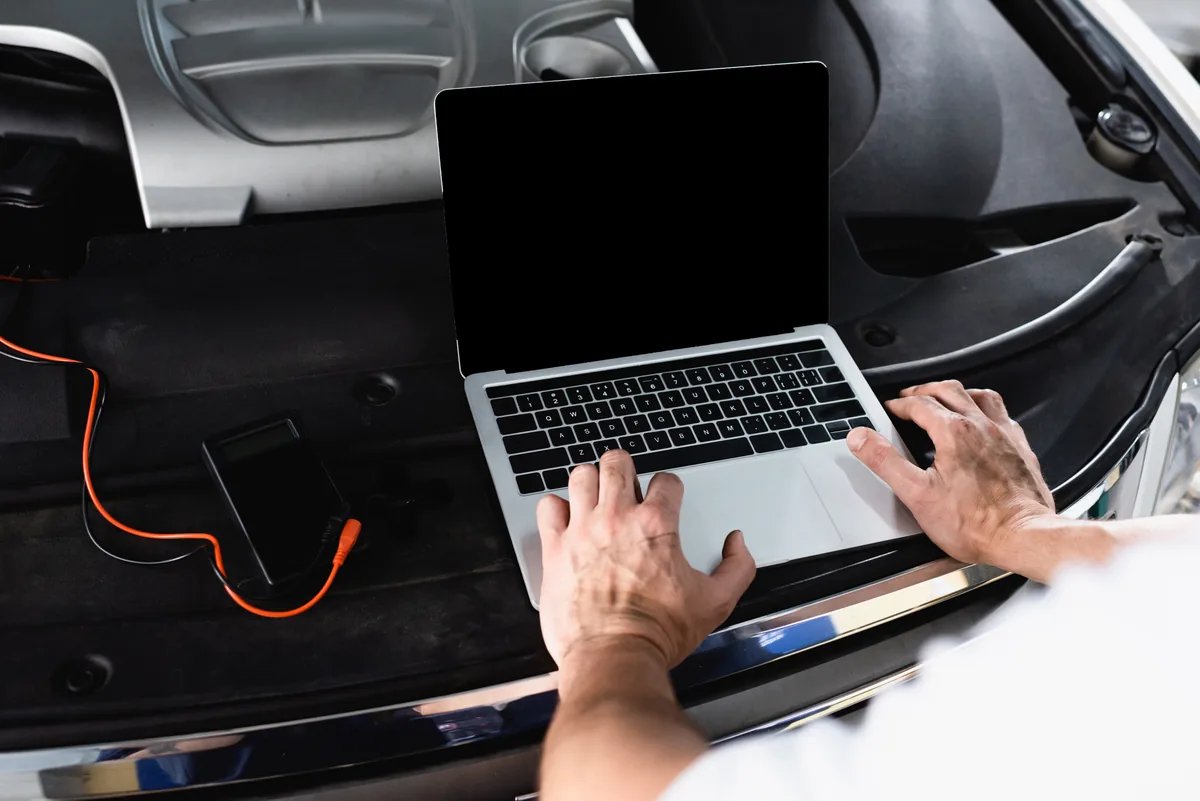
What every free tool gives you
The reason free OBD2 software exists at all is that the useful part is standardised. Since OBD2 became mandatory, every compliant car answers the same set of standard requests over the same connector. Nobody has to reverse-engineer anything to read a generic fault code, which is why there are dozens of free apps that do it.
What you reliably get for nothing:
- Generic P0xxx fault codes, read from the engine control unit.
- The ability to clear them.
- Basic live parameters — engine speed, road speed, coolant temperature, throttle position.
- Readiness monitor status, on most tools.
That is not a trivial list. For the classic scenario — light came on, want to know if it is serious before booking a garage — it is often enough.
The four places free stops being enough
1. The code without the explanation
A generic code is five characters. What you need is a sentence. Free tools vary enormously here: the better ones carry a decent generic list, and the thinner ones hand you “P0128” and leave you to search for it.
The bigger gap is manufacturer-specific codes. The generic P0xxx range is standardised, but manufacturers are also allowed their own codes — P1xxx, and manufacturer-defined entries in the B, C and U ranges — and those are where a great deal of real diagnostic information lives. A tool with a thin database will read the code and then not know what it means. AutoScan’s database covers 14,309 codes, generic and manufacturer-specific, with plain-English descriptions. That is the single biggest practical difference between free and paid at the entry level.
2. Freeze frame
When the engine control unit stores a code, it also stores a snapshot of what the car was doing at that instant — engine speed, road speed, calculated load, coolant temperature, fuel trims. This is the difference between “there is a misfire” and “there is a misfire at 2,100 rpm under load on a cold engine”, which is a completely different investigation.
Free tools support freeze frame inconsistently, and when they do it is often partial. It is one of the things that separates casual tools from diagnostic ones.
3. Live data you can actually work with
Reading four parameters on a phone is not the same job as watching a dozen on a laptop while somebody revs the engine. Diagnosis by live data is mostly about relationships — what happens to long-term fuel trim when engine load changes, whether the upstream and downstream lambda signals move together or independently, whether intake air temperature and coolant temperature agree on a cold start. You need to see several things at once for that, and screen size stops being a cosmetic issue.
4. Systems beyond the engine
Generic OBD2 is, by design, mostly about emissions-related engine and transmission functions. ABS and airbag modules are outside that scope on most cars, which is why free generic tools generally cannot read them. If your warning light is an ABS light rather than an engine light, a free generic app usually has nothing to say about it.
Rough rule
If your question is “what is this code”, free is fine. If your question is “which of these three things is causing it”, you need live data and freeze frame, and that is where paid tools start earning their money.
Where free tools actually cost you money
Two ways, both indirect.
The first is parts roulette. You read a code, search it, find a forum thread where somebody replaced a sensor and it fixed theirs, buy the sensor. It does not fix yours, because your car had the same symptom from a different cause. That mistake costs more than any software licence, and it happens because you had the code but not the data that distinguishes between the candidates.
The second is diagnostic labour. A UK garage will typically charge something in the region of an hour of labour to plug in and investigate — commonly £50 to £100, more at a franchised dealer, less at a small independent, and it varies a lot by region. That is per visit, and it is charged whether the finding is a £12 hose or a £600 component.
What paying actually buys
Being concrete about it, here is what the editions cover so you can work out whether the thing you need is behind a paywall at all.
| Edition | Price | What it adds |
|---|---|---|
| Standard | £24.99 | Full 14,309-code database, read and clear stored and pending codes, lifetime licence key, 1 year of updates |
| Enhanced | £49.99 | Live data from over 90 sensors, freeze frame, ABS and SRS support, 2 years of updates |
| Enhanced PLUS | £64.99 | Bluetooth adapter support, mobile app, licensed for commercial use, 3 years of updates |
The step that matters most for diagnosis is Standard to Enhanced, because that is where live data and freeze frame appear. If you only want to read and clear codes with proper descriptions, Standard does that and Enhanced would be money you did not need to spend.
Worth knowing about the licensing model: it is a one-off purchase, not a subscription. The key does not expire and there is no limit on how many vehicles you use it on. What has a time limit is access to new update releases — one year on Standard, two on Enhanced, three on Enhanced PLUS — after which the software keeps working with the database you have.
The honest cases for staying free
Some situations genuinely do not justify paying, and saying so is more useful than pretending otherwise.
- One car, one light, one time. You want a yes or no on whether to worry. Free app, done.
- You are selling the car anyway. Spend nothing.
- You have no Windows machine. AutoScan is Windows software. If you are Mac-only and want to stay that way, a phone-based tool is your route.
- Your car predates OBD2. European petrol from 2001, European diesel from 2004, non-European from 1996. Older than that and there is nothing standardised to talk to.
- You need bidirectional control or module coding. That is professional equipment territory, and neither free apps nor entry-level paid software will do it.
The cost that catches everyone out
Whichever way you go, the software is not usually what fails. The adapter is.
ELM327 interfaces have been cloned into the ground, and a large proportion of the cheapest ones support only some protocols, misreport their firmware version, or drop the connection partway through a read. The failure looks like a software problem and is not. If you are going to spend anything at all in this area, spend it on a decent wired adapter before you spend it on software — a bad adapter makes the best software in the world useless, while good software cannot fix a bad adapter.
A sensible order to do this in
Start free. Get a reliable adapter, install something that reads generic codes, and see whether that answers your question. A good proportion of the time it will.
If you find yourself with a code you cannot interpret, a fault that comes and goes, two plausible causes and no way to choose between them, or a second car in the household, that is the point at which paying stops being an upsell and starts being cheaper than the alternative. There is a free download that lets you confirm the software installs and finds your adapter before you buy anything, though it is deliberately limited and will not read codes or show live data until it is licensed.
Work out which edition you actually need
The comparison page lists what each edition covers, so you can buy the one that matches the job rather than the biggest one.
Read it yourself
Stop guessing at the code
AutoScan reads the fault straight out of your car and tells you what it means in plain English, on your own Windows laptop. The trial reads real codes before you pay anything.
Keep reading
Related guides
P0455 Large EVAP Leak: Start With the Fuel Cap
A large evaporative leak is the one EVAP fault you can often find yourself in five minutes, and the fuel cap is…
P0301 Cylinder 1 Misfire: Find the Cause Before Buying Parts
How to use the coil and injector swap test to prove which part is faulty on cylinder one, so you replace the…
MOT Emissions Failure: Find the Cause Before the Retest
An emissions fail tells you the numbers were wrong but not why. Here is how to read the failure sheet, work out…